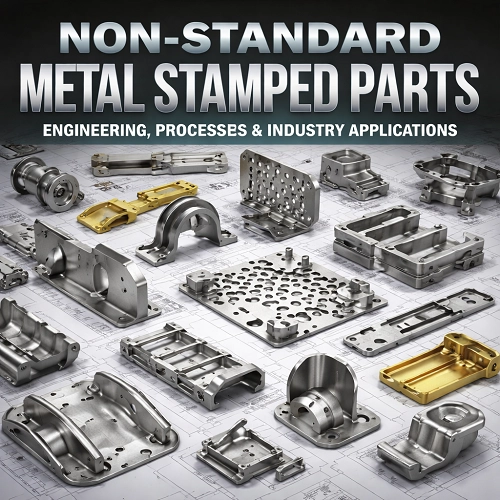
Non-standard metal stamped parts — also called custom stamped parts or bespoke stamping components — are sheet-metal products manufactured to customer-specific drawings rather than off-the-shelf catalogues. Unlike commodity hardware, each geometry, alloy grade, surface treatment, and dimensional tolerance is engineered to satisfy a particular assembly requirement, making these parts the backbone of complex manufactured goods in automotive, truck-body, garage-door, furniture, and outdoor equipment sectors.
ACRO Metal's full stamping-parts portfolio covers the breadth of this discipline, ranging from simple bracket forms to multi-feature progressive-die assemblies. The company designs and fabricates tooling in-house, enabling rapid iteration between concept and production release.
Selecting the correct base material is the single most important pre-production decision. Material choice affects formability, corrosion resistance, weight, weldability, and cost. The table below summarises the most common alloy families used in non-standard stampings.
| Material | Typical Grade | Tensile Strength | Key Advantage | Common Application |
|---|---|---|---|---|
| Cold-Rolled Steel (CRS) | DC01 / SPCC | 270 – 410 MPa | Excellent surface finish, high formability | Interior trim brackets, office furniture frames |
| Galvanized Steel (GI / GE) | DX51D + Z / SECC | 270 – 500 MPa | Integral zinc coating, corrosion resistance | Windshield base channels, garage-door hardware |
| High-Strength Low-Alloy (HSLA) | S420MC / QSTE420 | 420 – 550 MPa | High strength at reduced thickness (weight saving) | Truck body panels, structural cross-members |
| Stainless Steel | SUS304 / SUS316 | 515 – 690 MPa | Corrosion & heat resistance without coating | Outdoor kitchenware, food-contact components |
| Aluminium Alloy | 5052-H32 / 6061-T6 | 193 – 310 MPa | Lightweight, anodisable | EV battery trays, decorative trim |
Table 1 — Comparative overview of stamping alloy families and typical applications.
For automotive exterior trim and structural sealing applications, galvanized grades such as DX51D+Z are the dominant choice. ACRO Metal's Galvanized Base Profile for Auto Windshield exemplifies this: the part is stamped from galvanized sheet and must meet a flatness tolerance of ±0.6 mm across a span of 1,195 mm — a tight demand that requires precise blank-feed control and die-surface engineering.
Non-standard parts rarely involve a single operation. A typical component may pass through several press stages before it reaches finished dimensions. Understanding the available processes helps engineers select the most cost-effective manufacturing route.
Blanking shears the outline of a flat blank from coil or sheet. Fine blanking adds a compression ring that eliminates fracture on the cut edge, yielding a burnished, square surface suitable for mating faces or threads without secondary operations.
A strip of metal advances through a series of stations in a single die set. Each stroke simultaneously performs piercing, forming, bending, and cutting operations. Progressive dies are ideal for high-volume, medium-complexity parts because they minimise handling and deliver consistent inter-feature relationships.
A blank is drawn into a die cavity by a punch, forming a cup or shell without changing the material thickness significantly. Draw ratios up to ~2.2 are achievable in a single pass with low-carbon steel; subsequent re-draw operations increase depth further.
For long, channel-type profiles — such as the windshield base profile (1,195 mm × 41 mm × 30 mm) manufactured on a 300-tonne press and CNC bending machine — dedicated bending is necessary because a progressive die cannot economically accommodate metre-long parts.
Tolerance requirements for non-standard stampings span a wide range, depending on function. Structural brackets may accept ±0.5 mm on non-critical features, while sealing channels and mating interfaces often call for ±0.1 mm or tighter. The table below provides typical stamping tolerance classes aligned with ISO 2768.
| ISO 2768 Class | Linear (3–30 mm) | Linear (30–120 mm) | Flatness (up to 300 mm) | Typical Use Case |
|---|---|---|---|---|
| f (Fine) | ±0.05 mm | ±0.10 mm | 0.10 mm | Precision electronics brackets |
| m (Medium) | ±0.10 mm | ±0.15 mm | 0.20 mm | Automotive sealing profiles, trim channels |
| c (Coarse) | ±0.20 mm | ±0.30 mm | 0.50 mm | Structural frames, furniture bases |
| v (Very coarse) | ±0.50 mm | ±0.80 mm | 1.00 mm | General brackets, non-mating covers |
Table 2 — ISO 2768 tolerance classes commonly referenced in custom stamping drawings.
ACRO Metal maintains a dedicated quality inspection function that deploys coordinate-measuring machines (CMM), optical profile projectors, and gauge fixtures to verify first articles and in-process samples against customer drawings.
Surface treatment extends service life, satisfies aesthetic requirements, and — for automotive components — meets OEM corrosion-resistance specifications such as a 500-hour neutral salt-spray test.
| Treatment | Process | Typical Thickness | Salt-Spray Performance | Best For |
|---|---|---|---|---|
| Hot-Dip Galvanizing | Immersion in molten zinc bath ≈ 450 °C | 45–85 µm | 500 – 1,000 h | Structural parts, outdoor hardware |
| Electro-Galvanizing (GE) | Electrodeposition of zinc | 5–25 µm | 240 – 500 h | Automotive stampings, appliance panels |
| Powder Coating | Electrostatic spray + oven cure 160–200 °C | 60–120 µm | 500 – 1,000 h (with primer) | Furniture, exterior panels, colour-critical parts |
| E-Coating (KTL) | Electrodeposition of epoxy primer | 15–30 µm | 500 – 720 h | Automotive interior trim, complex geometries |
| Zinc-Nickel Plating | Electrolytic bath with Ni co-deposition | 8–15 µm | 720 – 1,000 h | High-spec fasteners, safety-critical brackets |
Table 3 — Surface treatment options for custom metal stampings and indicative corrosion performance.
ACRO Metal offers powder-coated and e-coated variants alongside galvanized parts. Browse the E-Coating Panel for Auto Door and the Powder Coating Hook for Auto Interior Trim to see production examples of each finish applied to complex automotive geometries.
Windshield assemblies, door panels, interior trim mounts, mudshields, and seat tracks all rely on high-precision custom stampings. The Galvanized Base Profile for Auto Windshield — a commercial-vehicle interior trim part measuring 1,195 mm × 41 mm × 30 mm — is a representative example: it demands flatness within 0.6 mm, is produced on a 300-tonne stamping press, and uses CNC bending for the final profile form. See the full auto-industry application gallery for further case studies.
Truck panels and structural cross-members require HSLA grades for weight efficiency and corrosion-resistant coatings for longevity. ACRO Metal's truck application line covers reinforcement channels, floor-support brackets, and cab-mounting hardware.
End caps, hinges, and track brackets for residential and commercial garage doors must withstand cyclic loading over tens of thousands of open-close cycles. The Galvanized End Cap Series I and Series II demonstrate how galvanized steel combines fatigue resistance with long-term corrosion protection in an outdoor cycling environment.
Desk frames, cabinet reinforcements, and precision brackets fall under ACRO Metal's furniture application, while stainless-steel outdoor kitchenware stampings — including pizza peels and grilling accessories — demand food-grade surface finish and consistent gauge control.
Many stamping suppliers sub-contract die manufacture, introducing lead-time risk and limiting process knowledge. ACRO Metal operates its own tooling manufacturing workshop and maintains a tooling warehouse that houses active and archive dies. This vertical integration means:
The company also holds technical patents covering specific stamping and forming techniques, a signal of genuine R&D investment rather than pure commodity production.
Complex sub-systems are rarely single stampings. ACRO Metal extends its capability into welded assemblies — MIG, TIG, and spot-welded structures — and assembled components that integrate fasteners, inserts, and secondary parts in a single shipment. This one-stop supply model reduces the customer's supplier count, inbound logistics complexity, and assembly-line handling steps.
From concept drawing to mass production, ACRO Metal delivers custom-stamped, welded, and assembled metal parts across automotive, truck, furniture, and hardware sectors. Based in Jiaxing City, Zhejiang Province, the facility operates 300-tonne class presses, CNC bending equipment, and an in-house tooling workshop — all backed by ISO-aligned quality inspection.
Email: sales7@acro-metal.com | Tel: +86-573-82799638 | No. 200 Weisheng Road, Xiuzhou Industrial Zone, Jiaxing, Zhejiang
Request a Quote